Artificial Intelligence and digital tools are transforming international trade, making market research, export planning, and international business development faster and more accessible. Today, exporters and SMEs can use AI-powered solutions to identify new market opportunities, analyze competitors, understand trade regulations, find international buyers and distributors, and automate time-consuming export activities. But with so many AI and digital tools available, which ones are the most useful for international expansion? In this article, we explore 10 essential AI and digital tools for exporters in the era of AI, with practical examples showing how businesses can improve export productivity, reduce internationalization costs, and accelerate their growth in global markets.
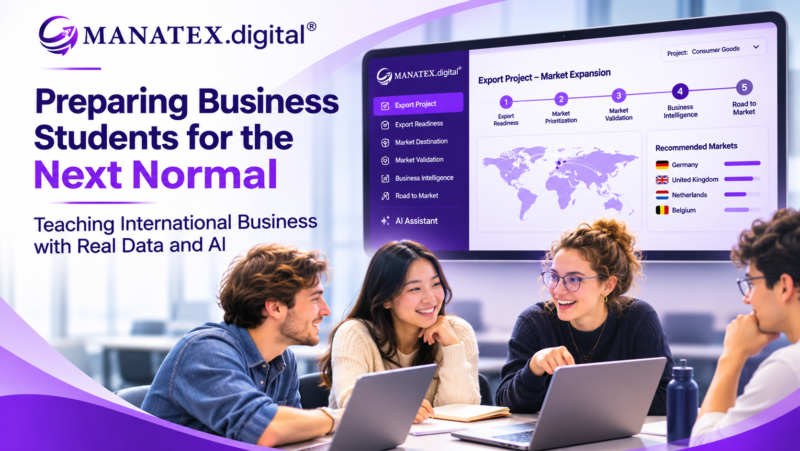
Manatex.digital: Your AI-Powered Strategic Intelligence Center for International Market Expansion
Main use: Complete international market expansion, from export readiness and market prioritization to market intelligence, go-to-market planning, B2B partner search and CRM-ready contact information.
Manatex.digital is an AI-powered market expansion platform designed for SMEs, exporters, international business developers and consultants.
Unlike general-purpose AI tools or individual market research databases, Manatex.digital provides a personalized strategic intelligence and knowledge management environment, built around each company’s profile, products, capabilities and international growth objectives.
The platform combines market intelligence, data analysis, expert decision-support systems and AI to help businesses manage their international expansion projects, from initial market selection to identifying and evaluating potential buyers and commercial partners.
How Hybrid AI Can Help SMEs Succeed in International Markets
What can exporters do with Manatex.digital?
1. Assess export readiness and prioritize markets
Evaluate the company’s export capabilities, identify potential international markets and prioritize destinations based on its products, resources and business objectives.
2. Build a personalized market expansion roadmap
Choose between a manual investigation or an AI-guided Roadmap. The platform recommends the market validation, business intelligence and go-to-market analyses needed to support the company’s objectives. Project Results brings the findings together into an overall assessment and recommendations.
3. Automate market research and business intelligence
Research local market conditions, industry developments, competitors, trade risks and other factors affecting international expansion. Follow relevant developments through customized market and industry news feeds.
4. Prepare a practical go-to-market strategy
Investigate market entry options, distribution channels, buyer behavior and purchasing processes. Use specialized research to identify market opportunities, relevant trade events, media channels and other activities that can support market entry.
5. Identify, evaluate and shortlist international buyers and partners
Build a longlist of potential buyers, distributors or commercial partners. Select relevant companies for further investigation, run company screening and background checks, and evaluate how well each company matches the exporter’s products and objectives.
6. Find business contacts and prepare for prospecting
Access company profiles and available contact information for shortlisted businesses. Manatex can enrich missing contact data using a service connected to approximately 40 data providers, helping exporters prepare company and contact records for CRM and commercial follow-up.
7. Centralize export intelligence and company knowledge
Keep market research, analysis, reports, project decisions and partner information organized within a single environment. Each project becomes a structured knowledge base that helps the company maintain continuity and make better-informed decisions.
Practical export example
A French food supplement manufacturer wants to expand into European markets and develop a network of local distributors.
Using Manatex.digital, the export manager can:
- Evaluate export readiness: Assess the company’s capabilities and preparation for international expansion.
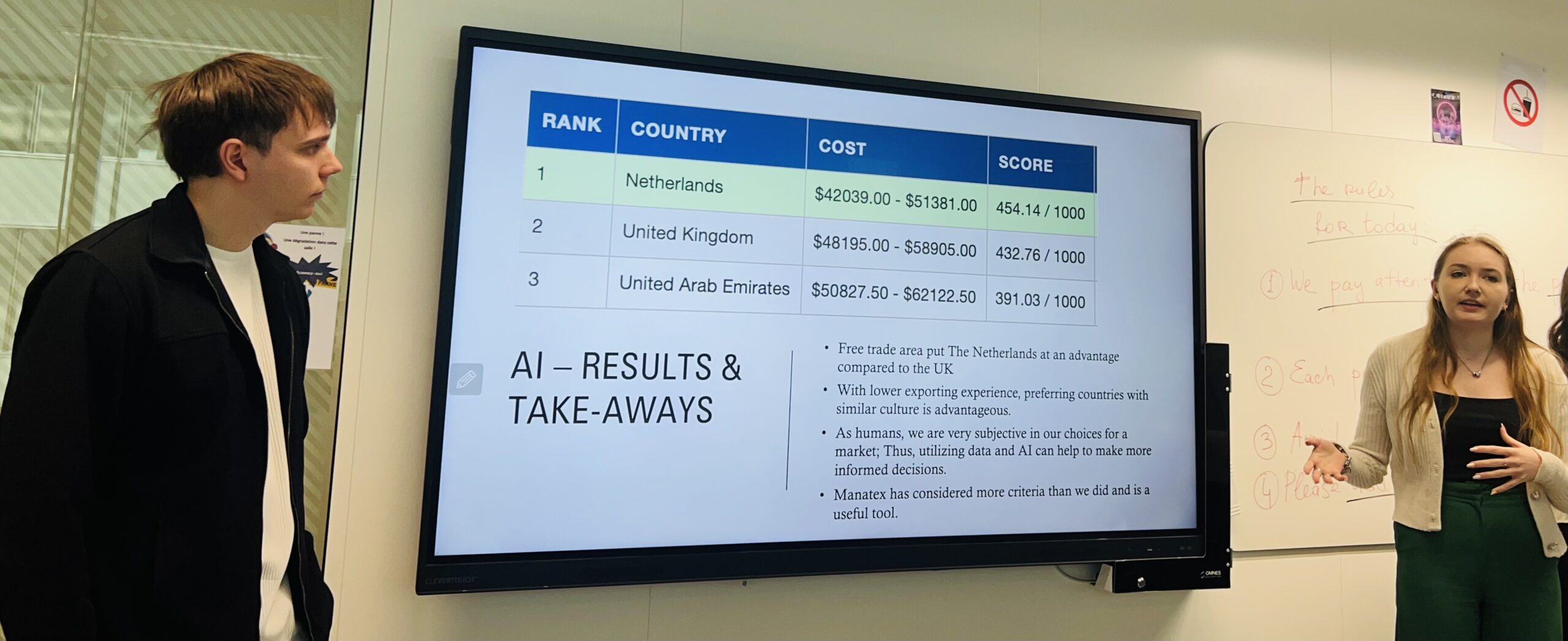
- Identify priority markets: Compare potential European destinations and select the most promising countries for further investigation.
- Validate market opportunities: Research local demand, competition, trade conditions and industry developments.
- Prepare the entry strategy: Investigate distribution channels, buyer purchasing behavior and relevant commercial approaches.
- Find potential distributors: Generate a longlist of relevant companies in selected markets.
- Screen and shortlist partners: Investigate companies, conduct background checks and evaluate their suitability.
- Identify decision-makers: Access company profiles and enrich available contact information, including business emails and phone numbers.
- Prepare for commercial action: Organize shortlisted companies and their contact details for CRM and targeted prospecting.
Rather than using separate tools and disconnected reports, the company can manage its investigation and prepare its international expansion activities within one personalized environment.
Manatex.digital helps businesses move from market questions to informed decisions, and from market intelligence to practical commercial action.
ITC Trade Map: Analyze International Trade Flows and Market Demand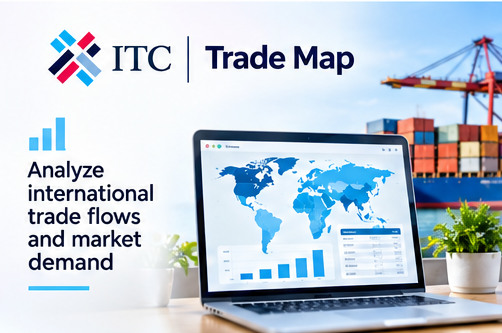
Main use: International trade statistics, market demand analysis and export opportunities.
ITC Trade Map is a trade intelligence platform developed by the International Trade Centre (ITC). It helps exporters understand international trade flows by product and country.
Using HS codes, exporters can analyze import and export values, growth trends, quantities, major supplying countries and market shares. The platform also provides trade indicators and company directories to support international business research.
Practical export example:
A French olive oil producer wants to expand into new markets. Using Trade Map, the export manager can:
- Identify countries importing olive oil.
- Compare import growth over recent years.
- Analyze which countries supply those markets.
- Prepare an initial shortlist of promising destinations for further research.
Choosing the right export market is one of the most important decisions for SMEs. Learn more about the common mistakes SMEs make in international expansion
ITC Export Potential Map: Discover Untapped Export Opportunities
Main use: Identify countries and products with unrealized export potential.
ITC Export Potential Map helps businesses discover international opportunities using economic indicators and trade data.
Unlike tools that mainly present historical trade statistics, Export Potential Map uses an analytical model to estimate potential trade opportunities based on supply capacity, demand and trade relationships.
Exporters can explore markets with unrealized potential for their existing products and investigate opportunities for product diversification.
Practical export example:
A Portuguese footwear manufacturer wants to increase its international sales.
The export manager can use Export Potential Map to:
- Identify countries with unrealized potential for Portuguese footwear.
- Compare estimated export opportunities.
- Explore which product categories offer additional growth opportunities.
These findings can help the company decide which markets deserve further analysis.
Euromonitor Passport: Understand Consumers, Industries and Competitors
Main use: Industry intelligence, market sizing, consumer research and competitive analysis.
Euromonitor Passport is an AI-powered market intelligence platform combining market data, industry research, company information and forecasts.
It helps international businesses understand market size, consumer behavior, distribution channels, brands, market shares and industry developments.
Passport AI also allows users to ask questions in natural language and explore the platform’s research more efficiently.
Practical export example:
A French cosmetics brand wants to enter the Japanese market.
Using Euromonitor Passport, the company can:
- Research the Japanese skincare market and its growth.
- Identify leading brands and their market shares.
- Study consumer preferences and purchasing behavior.
- Analyze distribution channels, including retail and e-commerce.
- Compare different skincare product categories before selecting products for the market.
This information helps the exporter adapt its product positioning and commercial strategy to local market conditions.
Perplexity: AI Research, Export Documents and Digital Agents

Main use: AI-assisted research, document preparation, simple applications and business task automation.
Perplexity combines AI-powered online research with document analysis and AI agents.
Exporters can use it to investigate international markets, collect information from multiple sources, analyze uploaded documents and prepare structured reports.
With Perplexity Computer and its reusable Skills, businesses can also create AI-assisted workflows for recurring activities. These include preparing commercial proposals, working with spreadsheets, creating simple calculators and completing certain browser-based tasks.
Practical export example:
An industrial equipment manufacturer receives an inquiry from a potential distributor in the UAE.
The export manager can use Perplexity to:
- Research the distributor’s business.
- Analyze the company’s product catalogue and commercial information.
- Draft a distributor proposal adapted to the UAE market.
- Create a simple quotation calculator using the company’s prices and shipping assumptions.
- Prepare answers for a distributor or supplier registration form.
- Create a reusable AI Skill to follow the same process for future international inquiries.
The export manager then reviews the prepared documents and commercial information before sending them.
Similarweb: Analyze Online Competitors and Digital Market Opportunities
Main use: Digital competitive intelligence, website traffic analysis and online market research.
Similarweb provides insights into website performance, audience geography, traffic sources, search keywords and online competition.
For exporters, it offers a practical way to investigate how competitors attract customers in different countries.
Businesses can compare websites, study their digital visibility and investigate which search engines, referral websites and marketing channels bring visitors to their competitors.
Practical export example:
A European food supplement brand is preparing to enter Germany.
Using Similarweb, the export manager can:
- Compare the websites of established German competitors.
- Study their estimated website traffic and audience engagement.
- Identify keywords attracting potential customers.
- Investigate important online traffic channels and referral sources.
- Discover relevant websites to examine as possible marketing or distribution channels.
These insights help the company better understand the local digital environment before launching its products.
Access2Markets: Research Tariffs, Trade Agreements and Export Requirements
Main use: Customs duties, rules of origin, trade agreements and market access requirements.
Access2Markets is the European Commission’s online trade information portal.
It helps businesses research the requirements for trading goods and services between the EU and international markets.
Exporters can search by product or HS code, origin country and destination country to investigate applicable customs duties, taxes, rules of origin, trade procedures and relevant product requirements.
Its ROSA tool also supports rules-of-origin self-assessment under applicable trade agreements.
Practical export example:
A French biscuit manufacturer wants to export its products to Canada.
Using Access2Markets, the export manager can:
- Search for the correct product classification.
- Check the applicable customs duties.
- Investigate preferential tariff treatment under the EU-Canada trade agreement.
- Review rules of origin and supporting documents.
- Identify relevant import procedures and product requirements.
The company can use this information to prepare its export cost calculations and shipment documentation.
Kompass: Find International Buyers, Importers and Distributors
Main use: B2B company discovery, commercial partner search and international prospecting.
Kompass is an international B2B company information and prospecting platform.
Its EasyBusiness solution helps companies search for potential clients, distributors and other business partners using criteria such as location, business activity, products, company size and turnover.
Export teams can build targeted prospect lists, access available business contacts and organize commercial follow-up.
Kompass also uses AI-powered search capabilities to help identify companies matching specific business profiles.
Practical export example:
An Italian industrial packaging manufacturer wants to develop its sales in Poland.
Using Kompass, the export manager can:
- Search for packaging distributors and industrial wholesalers in Poland.
- Filter companies by sector, activity and size.
- Identify companies dealing with relevant packaging products.
- Create a list of potential importers and distributors.
- Collect available company and contact information for commercial prospecting.
The resulting list can become the starting point for a targeted international sales campaign.
how AI can improve international distributor search
LinkedIn Sales Navigator: Find Decision-Makers and Develop International B2B Relationships
Main use: International B2B prospecting, decision-maker identification and relationship development.
LinkedIn Sales Navigator is a professional sales intelligence tool that helps businesses identify and engage with potential clients and commercial partners.
Its advanced search functions allow exporters to filter companies and professionals by geography, industry, company size, job title, seniority and other criteria.
Sales Navigator also helps sales teams monitor target companies, identify useful connections and prepare more personalized commercial approaches. Its AI features support account research and sales preparation.
Practical export example:
A French manufacturer has identified several potential distributors in Saudi Arabia.
Using Sales Navigator, the export manager can:
- Search for purchasing directors, business development managers and company owners.
- Identify relevant decision-makers within the shortlisted companies.
- Research their professional backgrounds and business interests.
- Find possible introductions through existing professional contacts.
- Monitor company developments and prepare personalized approaches.
This helps the exporter move from a list of potential partner companies to contact with the right people.
Make: Automate Export Activities with AI Agents and Digital Workflows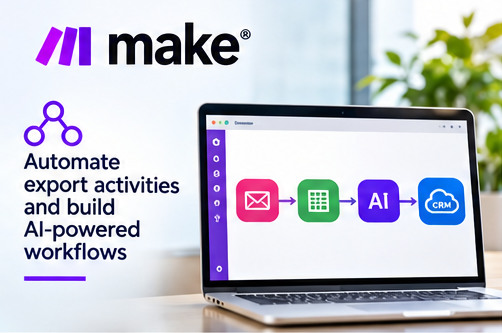
Main use: Business process automation, AI agents and integration between digital tools.
Make is a visual automation platform that allows companies to connect business applications and create automated workflows.
It helps exporters reduce repetitive administrative and commercial tasks by connecting tools such as email, spreadsheets, CRM systems, online forms and databases.
With Make AI Agents, businesses can also build intelligent workflows that process information, classify requests, prepare documents and trigger actions across connected applications.
Practical export example:
A manufacturing SME receives international inquiries from its website, trade fairs and distributor network.
The export manager can create an automated workflow that:
- Collects new inquiries from email or online forms.
- Extracts company names, countries, requested products and quantities.
- Uses an AI agent to classify inquiries by market and product.
- Creates or updates prospect records in the company’s CRM.
- Prepares a draft response or quotation request.
- Notifies the responsible export manager when human review is required.
This helps the company organize international inquiries and improve sales follow-up without manually repeating the same administrative steps.
Disclaimer: This article is for informational purposes only. All trademarks, logos, and product names belong to their respective owners. The images are illustrative and are not official product screenshots. The tools are presented independently, without any affiliation, endorsement, or sponsorship unless explicitly stated. Features and services may change over time