Business simulations have been part of international business education for decades. But in today’s AI-driven world, are they still preparing students for real international markets?
International business has changed dramatically over the last five years. Export managers now deal with tariffs, sanctions, AI, geopolitical risks, sustainability regulations, and rapidly changing supply chains. Universities therefore face an important question: are traditional business simulations still enough to prepare students for this reality?
On paper, it sounds ideal: give students a virtual budget, put them in competing teams, and let them battle for market share in a controlled environment.
However, ask any professor who has run these sessions for years, and a familiar pattern emerges. By Round 3 or 4, students aren’t discussing real-world trade barriers, tariff structures, or cultural adaptation. Instead, they are trying to figure out how the software’s hidden mathematical code works. They discover that putting 80% of their budget into a specific marketing channel guarantees a high score, or that cutting R&D in a specific quarter tricks the system into boosting immediate profits.
In other words, they aren’t learning how real markets operate, they are simply learning how to win a game…
What Academic Research reveals about business simulations?
The disconnect between traditional classroom games and real-world execution is well-documented across educational and management research:
- Students “Game the System” Instead of Strategic Learning: Research on digital learning environments demonstrates that when students face automated, rule-bound software, they naturally pivot toward exploiting algorithmic quirks rather than mastering strategic principles.
- The Transfer-of-Learning Deficit: Studies published in the Decision Sciences Journal of Innovative Education show that performance inside closed simulation loops rarely translates to unscripted, real-world business scenarios. Because games strip away genuine market friction, ambiguity, and messiness, students struggle when confronted with actual business data.
- Rigid Code vs. Real Market Complexity: Software engineering and management studies highlight that traditional simulation games operate as closed-loop systems. They force complex global trade into fixed formulas, training students in oversimplified cause-and-effect logic that fails in real-world expansion.
- Extrinsic Rewards Over Deep Skill Retention: Systematic reviews of higher education gamification show that while leaderboards temporarily boost motivation, over-reliance on point systems often compromises long-term retention of core business concepts.
Moving Beyond Toy Games to Live Intelligence
In the actual enterprise, international trade is no longer governed by static playbooks or predictable yearly forecasts. Modern business leaders navigate real-time tariff updates, shifting supply chains, strict compliance demands, and massive streams of market data.
To prepare students for this reality, business schools are beginning to replace artificial “toy” simulations with live, industry-grade tools.
This is where Manatex.digital transforms classroom dynamics in international business education. Rather than forcing students into a closed computer game with predefined outcomes, Manatex provides a live, AI-powered internationalization platform the same kind of technology used by real exporters and international consultants.
Institutional Impact in Action
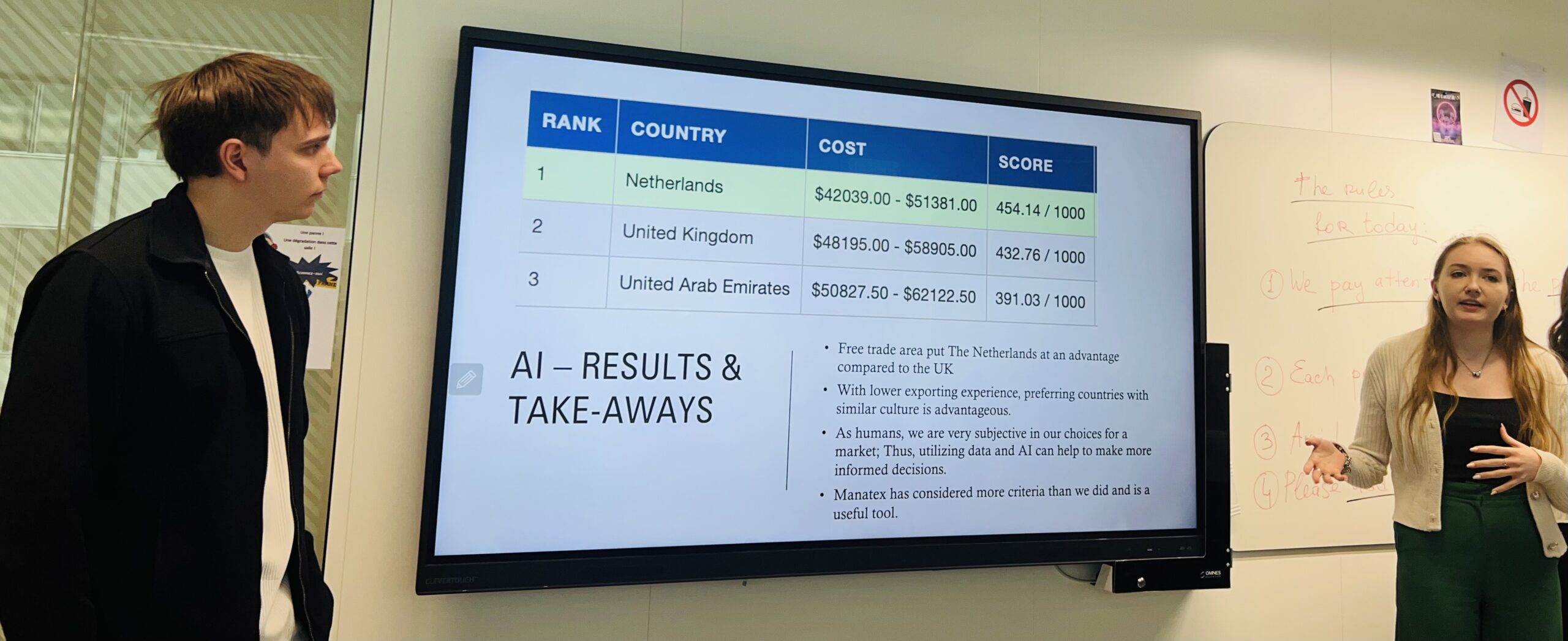
- ESCE Business School (Paris): In a project with Master’s students in International Strategy, students used Manatex ai platform to analyze real consumer-goods SMEs expanding across global markets. Instead of guessing arbitrary inputs in a software game, students conducted authentic export-readiness assessments and validated target markets using live trade analytics. As one student noted: “Manatex.digital asks precise, real about company capabilities. Generic AI tools are much more superficial”
- Curtin University Collaboration: Manatex has partnered with Curtin University to integrate Manatex AI platform workflows directly into international business classes. Students and faculty use the platform to work with real SMEs – evaluate real market opportunities, navigate regulatory hurdles, and ground strategic decisions in authentic trade data rather than artificial scoring matrices.
Elevating the International Business Curriculum
AI in higher education and real-time analytics are not replacing strategic decision-making; they are elevating it. When business schools step away from algorithmic games and introduce live industry platforms, students stop playing for points and start thinking like global strategists.
Bring Live Trade Intelligence to Your Classroom
Upgrade your curriculum for the upcoming semester with real-world market intelligence tools. We provide ready-to-use course modules, real SME case studies, and full faculty onboarding.
Contact us to get more details: nadya@manatex.co